Showing posts with label #artworkshop. Show all posts

Wednesday, February 12, 2020

The Dry Spells

I believe that most people who are involved in creative endeavors hit dry spells occasionally. The past couple months have been quite dry for me. Dry spells aren't necessarily bad, though. They can be a time of renewing, resting, getting centered again.

In early December, I finished up a class at On-Track Studios in Franklin taught by Karen Philpott. I really like Karen, and ended up with several paintings I like as a result of the classes I took from her.

This is my favorite. It is painted from a photograph that Karen provided us. She had a selection of photographs for us to choose from, and I chose this one because I love the contrast of the cold icy snow in the foreground to the warmth of the sky in the background. In looking at it with fresh eyes, though, I think there needs to be some of that gold color from the sky reflected on the snow. So I might go back and do that. It would unify the two parts of the painting.

This next one is also from a photo provided by Karen. I like this one, too.

This one was done in Karen's water reflections class back in late summer. I don't recall if I've written about or posted this one or not. It was painted from another of Karen's photographs.

This next one is a small painting - from my imagination. I love doing the water and the reflections of the boat and the land and the sky.
My sister, Debi, gave me a photo of a scene from their visit to Greece a couple years ago. I painted it for her. If I had it to do over again, I'd leave out that pier or whatever it is on the left. But I finished it, varnished it, framed it, and gave the painting to Debi. So it's done and gone - with the pier.

And now - this dry spell is into its third month, and I'm ready to bring on the rain of painting. In the next few months, I have quite a few painting opportunities that are exciting and that I'm anticipating with a lot of joy.

Friday, September 13, 2019

9 Suggestions for the Beginning Artist

9 Suggestions for the Beginning Artist

It might seem presumptuous for a newbie artist such as myself to offer advice for other artists, but who would know better what a beginning artist is going through than someone who has recently been through the beginning phases herself? I’ve only been painting for about four years now. All those initial growing pains are still fresh on my mind, and I’m still working on these suggestions in my own art. I’m not going to give you advice about technique or craft. This is about the practical, nuts and bolts of getting started as an artist. They are the things I struggled with at first or that I found to be most helpful to me. So, for those of you who are just embarking on your art journey, here are my suggestions to make the road a little smoother and more enjoyable.

(1)    Create an “Artist’s Statement.” I know . . .  having an artist’s statement sounds all hoity-toity. However, I can tell you that it makes a BIG difference!  Even for an absolute beginner! Your vision as an artist is what drives everything else. The process of writing an artist’s statement is invaluable. It forces you to think through your whys and hows. It will help you solidify your focus and purpose in painting. It will keep you from wasting time on things that don’t fit your vision. Set aside an hour or two, and get it done. Then post it where you can see it when you paint. Here’s a link to a blog post I wrote about how I came up with my own artist’s statement. http://marycarolart.blogspot.com/2019/06/an-artists-statement.html. Check it out if you want to know more about my process.
Be prepared: Your hopes and plans for your art will change as time passes and you paint more, and that means your artist’s statement will change, too. That’s a good thing because it shows that you’re growing.

(2)    Gather the materials you will need. Nothing will kill your desire to paint more than having a great painting idea but not having the materials to follow through. Often, by the time you gather all the materials, that inspirational spark has fizzled. Make a list of the supplies you will need, and then get them. If you don’t know what you need, research it. The internet is a great resource for information, but don’t take one source’s word for it; check out several. Make sure your materials include a sketch book that’s small enough to carry around with you so you can make quick sketches when you find yourself in a waiting room or with time on your hands.

(3)    Set up a dedicated space for painting. It doesn’t have to be a big studio, but it does have to be a space for art and nothing else. You won’t paint much if you must clear away papers, dishes, or toys every time you want to paint. I started out with a desk in a spare bedroom, and later I converted our bonus room into a studio. Your studio is whatever make it; it can be a table in the corner of your bedroom, a desk in the kitchen, or an easel set up in the laundry room.  It can be a spare bedroom, space in your garage, or anywhere that you can create an area just for your art. You will need some type of shelving or cart to keep your supplies. Once you’ve claimed your space, set out the materials you gathered in #2 above and have them ready to be used.

(4)    Take workshops and/or lessons from a variety of artists. Find available classes and workshops by checking out community centers, calling your local arts council, getting online to research, calling nearby colleges and universities, or checking the arts section of your local newspaper. Then sign up for a workshop that most closely matches your own interests.

When you take a workshop, go in with an open mind. I can’t tell you how many times I’ve attended a workshop and seen a student or two so involved in their own painting that they don’t pay attention to the teacher’s demos or instruction. You’re there to learn. Embrace the experience – follow the instructor’s suggestions – try out new techniques and materials – use the instructor’s palette – take notes. When you go home after the workshop, practice what you learned. Keep what works for you. Some things will resonate with you; others won’t. Also, talk to the other workshop participants. Get to know them. They will likely share with you about other art opportunities. If you like the artist/instructor, find out what other classes they teach. Workshops are vital to growing as an artist. Even nationally recognized artists take classes in order to keep learning and growing.

(5)    Get involved in the art community. There is a thriving art community on many levels – local, state, region, national, international. In the few years that I’ve been painting, I’ve added an entirely new dimension to my circle of friends and experiences. Here are some suggestions for involvement. You can’t do them all, but you can pick and choose the ones that appeal to you the most.

a.       Find and join local art groups. Once you’ve joined one or two local groups, get involved. Volunteer to help with shows and paint-outs. You don’t have to be an amazing artist to be involved in the art world. Does your community have “art crawls” each month? One caution: Don’t over-extend yourself. Start small and make decisions about your involvement based on your artist’s statement. Will this group help me reach my goals? Is this group’s vision in line with mine?
b.       Subscribe to and read art magazines. (Fine Arts Connoisseur, Plein Air Magazine, etc.) Regularly set aside time to read them and keep up to date with what’s going on in the world of art. It’s fun to read about all the shows, conventions, and galleries and see the art that other people are producing.
c.       Join artist groups on Facebook, Instagram, and other social media, and “friend/follow” other artists. Artists generally post their work, and you can see what other artists are doing. If someone posts a painting you like, leave a comment telling them you like it. That helps to start building relationships.
d.       Join Associations such as Outdoor Painters Society, American Impressionist Society, Inc., and Oil Painters of America. Find groups for the medium(s) you use. Associations offer information, videos, workshops, paintouts. and competitions. They provide opportunities to network and learn. They also sponsor shows that give you the opportunity to submit your art for consideration.
e.       If you’re interested in plein air painting (painting outdoors), then do your best to attend the annual Plein Air Convention and Exposition (PACE). You’ll be with hundreds of other artists and have dozens of well known artists that provide sessions about elements of painting. Participate in as many of the sessions and activities as you can. 

(6)    Be patient. When I started painting, I wanted to be a great painter IMMEDIATELY! I wanted to instantly know about how to mix colors and how to paint impressionistically! It doesn’t happen that way, though. Learning takes time and practice. You’re embarking on a marathon – not a sprint. Remember that, as you continue to paint, you WILL improve, and you WILL learn. It is through this process that you will develop your voice as an artist.

(7)    Embrace your vulnerability. I can’t stress enough how important this is! It’s what I had to work on the most. When you paint, you are baring your soul and heart. It can be painful to put your art out there where others can comment and pass judgment on it. Every doubt and insecurity you ever had will push itself to the forefront. Don’t let your vulnerability freeze you, though. Remember: Different people = different styles of painting. You are the only you. It can be intimidating to go to that first (second, third, hundredth) workshop where you paint in front of people and where a professional artist/teacher (gasp!) will critique your art. Embrace the fact that you’re human and not perfect. It’s okay to be a beginning artist with much to learn.

I want to share a quick story to illustrate: When I attended my first Plein Air Convention and Exposition (2018), I didn’t know what to expect. It was in Santa Fe, and there were so many people there. I was intimidated because I only knew one other person. I attended lots of sessions and went on the paint-outs but did not participate in the social activities. I felt so out-arted by all the amazing artists there that I ended up isolating myself. When I signed up for the next year’s PACE, I resolved to jump into the activities and participate more. That year (2019), it was in San Francisco, and it was a much better experience. I met more people, finished some paintings, and learned more. At one point when I was walking back to the bus after painting the Golden Gate Bridge from Lands End, I remember looking at the gorgeous scenery and all the artists painting and thinking, “I love this!” THAT is the feeling you’re looking for! And that is the result of embracing my vulnerability as a newbie artist.

I deliberately use the word “embrace” rather than “accept” because embracing indicates an enthusiasm. It’s a good and valuable thing to be vulnerable. Go ahead and post your paintings on your Facebook, Instagram, and Pinterest pages. You are you, and there’s no one else that will paint like you.

(8)    PAINT. Do your art and don’t let anything stop you. We all likely know one or two people who talk about being an artist, but they never quite get around to actually painting. Don’t let that white canvas or panel intimidate you! You are the boss of your art! Sling a little paint on that canvas. Make a commitment to paint every day for a week. Or commit to three days each week. Set a do-able goal and then do it! The simple act of starting a painting is often all that’s needed to get you going. It doesn’t have to be perfect. That’s the beauty of art. You can always wipe off the paint or paint over it.
I was an elementary school reading specialist for many years, and one thing I often told students was that “the more you read, the better you’ll read.” I told them that reading lots of “easy” books” would enable them to move to harder books much more quickly. The same is true with painting. The more you paint, the better you’ll paint. And painting easy subjects repeatedly will enable you to paint more difficult subjects. I will say it again – You are the boss of your art! So get busy art-ing! Throw that paint around!

(9)    ENJOY the journey! Painting will change your life. You will never look at clouds or trees or flowers or even an apple the same way again. You will never see a white cloud again because now your newly awakened “artist eyes” will see all the purples and browns and oranges that are in there. You’ll gain a new vocabulary and start talking about cast shadows, local color, values, chroma, saturation, and shapes. You’ll become an obsessive photographer – always aware of the need to get shots of scenes you might want to paint someday. It’s a lovely and healthy way to live – with heightened awareness of the beauty of the world around you – the textures and colors and intricacies of nature.

Being an artist is a calling – a calling to journey through this life being more observant, more caring, more intuitive. A calling to embrace your imperfections, to explore your world, and to translate your deepest thoughts and emotions into color on a canvas. Enjoy the journey.

Sunday, August 25, 2019

Second Day of Still Water Workshop

I went to the second session of the "still water" painting workshop taught by Karen Philpott. I am learning a lot from this workshop. I love that it is so motivating for me. I've come home from each of the two I've attended so far, eager to get in my studio and paint!

A side note of general workshop info: One of the best things about this particular workshop is that Karen doesn't demo for HOURS. At some of the workshops I've attended (by both well-known and not-so-well-known artists) the artist would get so wrapped up in his/her own painting that they'd spend literally hours demo-ing how to paint a particular scene. The attendees end up sitting there watching for hours. And of course there are the attendees that hero-worship the artist and ask lots of questions and make lots of flattering comments, and so (in my opinion), the artist is off on a major ego-trip. In an all-day workshop, the demo would last ALL morning. I've had to employ the ever-handy "got to go to the bathroom" move just to stand and move around and get my blood flowing again. That's the reason there are two artists, in particular, that were so long with the obvious ego-inspired demo that I will never take another workshop from them.

Thank goodness, Karen doesn't do that! With Karen, she shows how she begins the painting and how she lays in the main shapes, and how she start laying in the lights, and then sends us to our set-ups to start painting the same photograph. She sets it up so we can see her finished painting of the scene (that she completed and framed before the workshop began) and the one she'd begun in class as a reference. The rest of the day is spent with us painting and Karen right there giving assistance.  It's a great plan of action for a workshop.

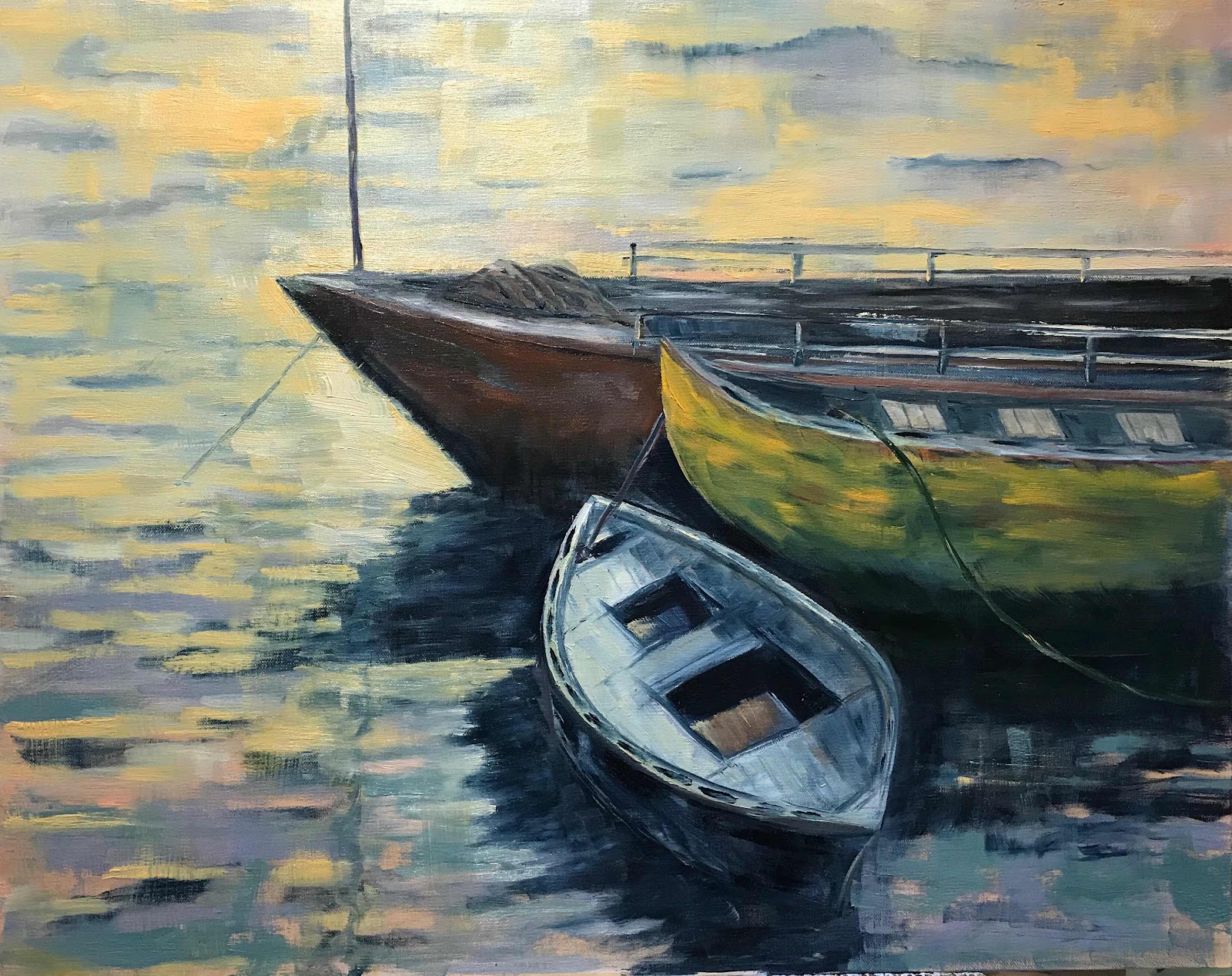
Here is my painting from day 2 of this workshop:
Oil on 16x20 linen panel
This week's photo reference was three empty boats tied up to a pier - although the pier isn't in the photo. There is actually the tip of a fourth boat in the far left of the photo, but Karen left that out, and so did I. 

I'm pleased with this painting. I may do a few more touch-ups after it has had time to dry a little.

Friday, August 16, 2019

Painting Still Water in a Landscape

Today I attended a workshop at On Track Studios taught by Karen Philpott. It was a really good workshop. Karen had a presentation showing how various artists have handled painting still water. It is really fascinating to see how different artists handle similar scenes. Then she demonstrated how to paint a still water scene. And then, each of us students started working on our own still water paintings.

Here is my painting.  I am pleased with it, and now I'm anxious to get back into my studio and try another still water painting.
"Morning Reflections" oil on 12x16 linen panel
After looking at the painting more, I made a few changes - nothing major - just a tweak here and there.  So this is the final painting:
"Morning Reflections" Oil on 12x16 linen panel


Monday, February 4, 2019

Dramatic Cloud Study

I took the following photo and wanted to paint the scene - with the clouds being the dramatic focus.


So I painted it. Here is my first attempt. Now, I have had two different "cloud lessons" from Rachael McCampbell over the past couple years - and doggone it, I STILL can't do clouds well.


So, after being totally unhappy with those clouds, I scraped off the sky entirely.


Then I painted it again.


Okay - it sucks. So I left it - figuring that if I let it dry a little overnight, it might work a little more easily.  Right now it's just a mass of paint. "Muddy" is the term that comes to mind. I will tackle it again in a day or two.

One thing I considered was that I used an Ampersand Gessobord for this painting. The Ampersand Gessobord has a very slick surface. Maybe I should have tried one of my Belgium Linen panels. I may re-do this scene on one of those. The other thing is that maybe I'm putting on the paint too thickly. I tend to be overly generous with my paint, and that makes it more difficult to finesse things like clouds. So there are two things to work on for this painting.

Stay tuned for more attempts. I know I can get the trees and the grass and the hay rolls to look right. They don't look right now because I've just blocked them in. But I know how to paint them. It's just the clouds right now that have me stumped.

#Oilpainting, #paintingclouds, #marycarolart, #cloudstudy

Sunday, December 2, 2018

Workshop with Kim Barrick

The past two days I've attended a workshop at Warehouse 521 with Kim Barrick teaching. The title of the class was "Fast and Furious" with the intent of painting more intuitively rather than getting bogged down with details.

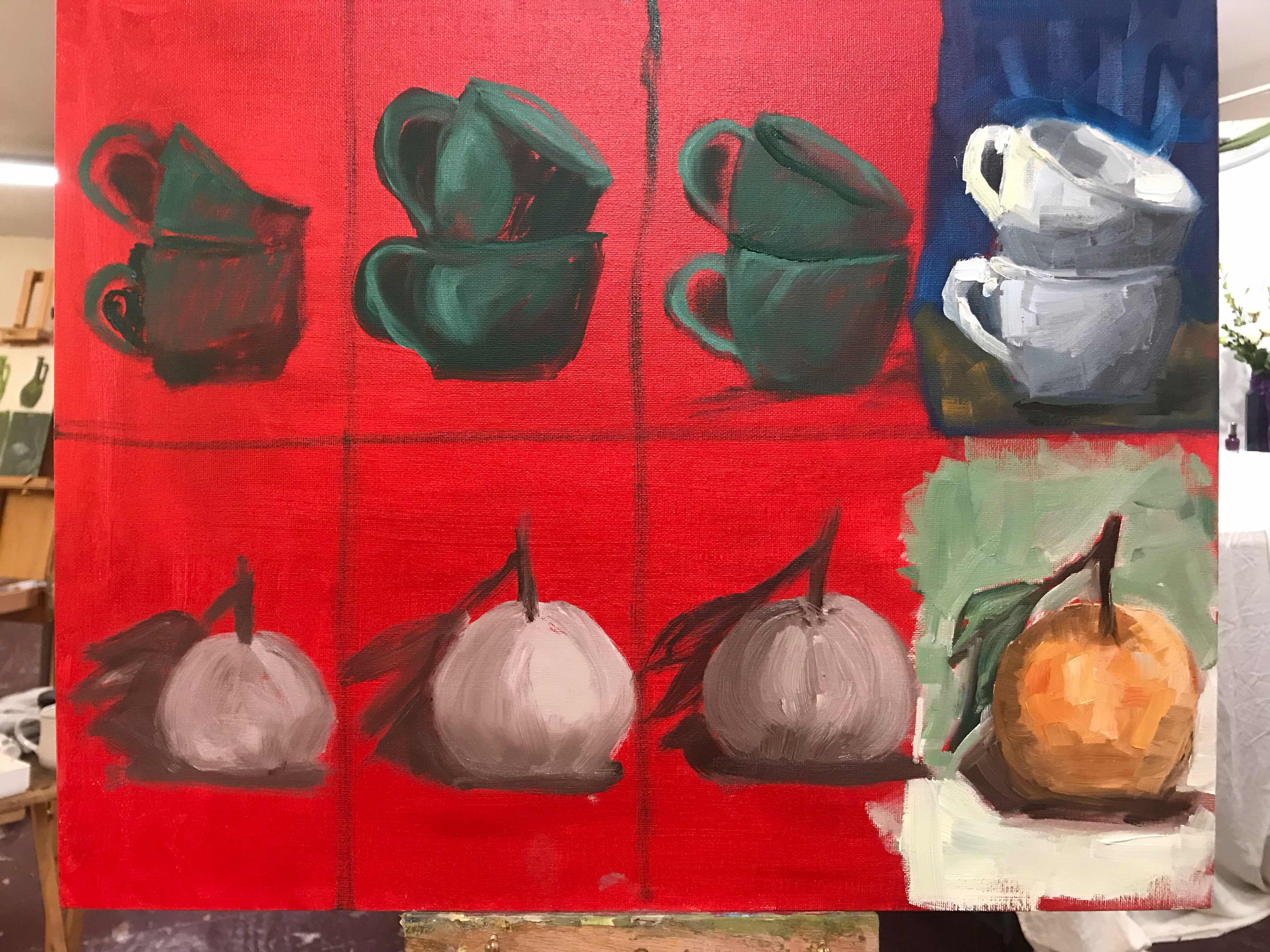
Each morning we started off with a timed series of paintings (see photo below).  The first day I did the two cups. For the first painting, we had 3 minutes and were to use two values of one color.  For the second one, we had 3 minutes and used 3 values of a color.  For the third one, we had 3 minutes and used 4 values of a color.  For the final painting, we had 5 minutes and could use any colors we wanted.  Kim also insisted we use a large brush - making little details impossible.  It was a great exercise.  The second day I painting the tangerine - which actually looks like an orange apple rather than a tangerine.  I MUST work on getting basic shapes right!  Still, I like the colors and the progression - and how the repetition made such a difference.


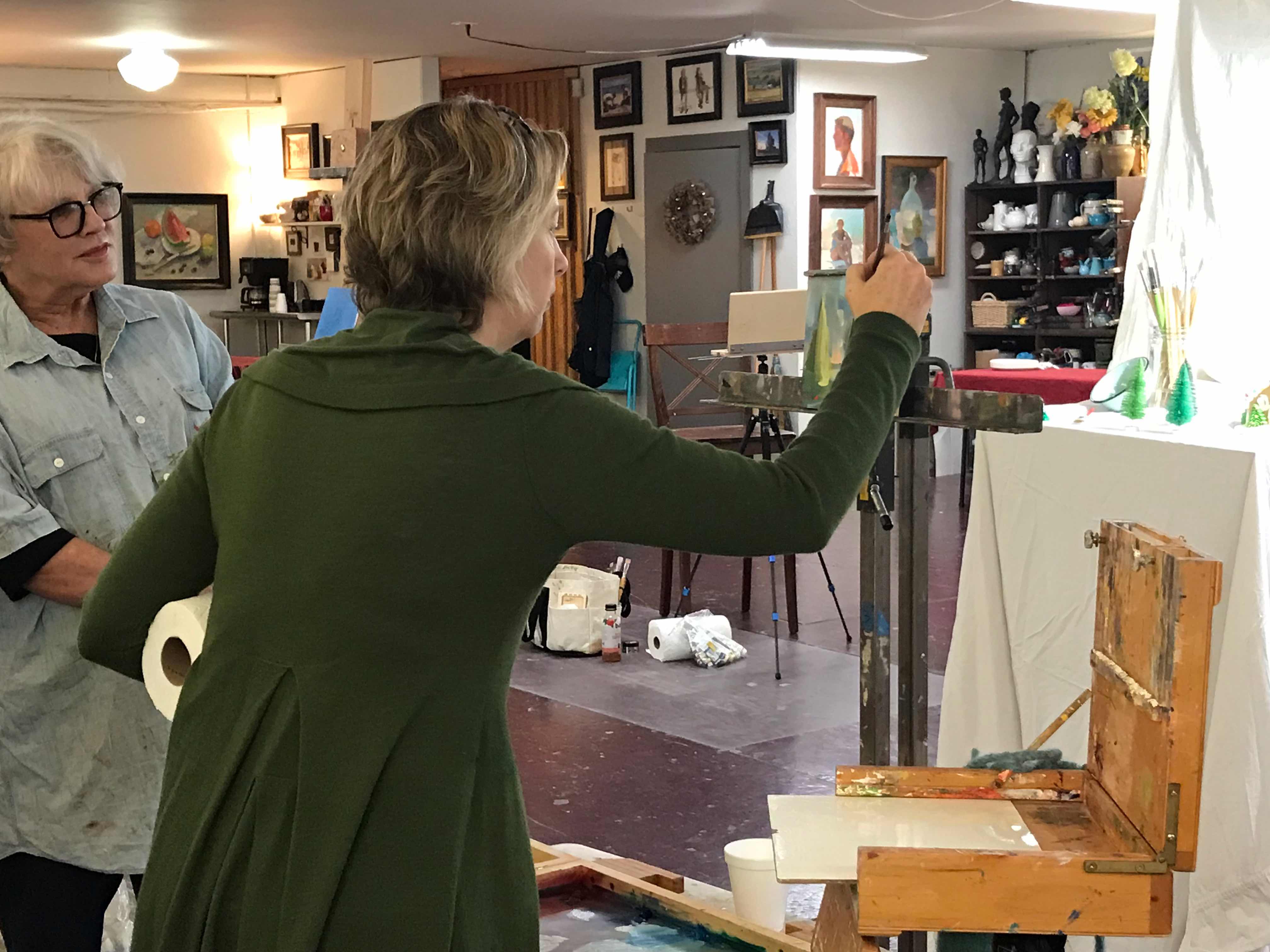
Here's a photo of Kim doing a demo painting.

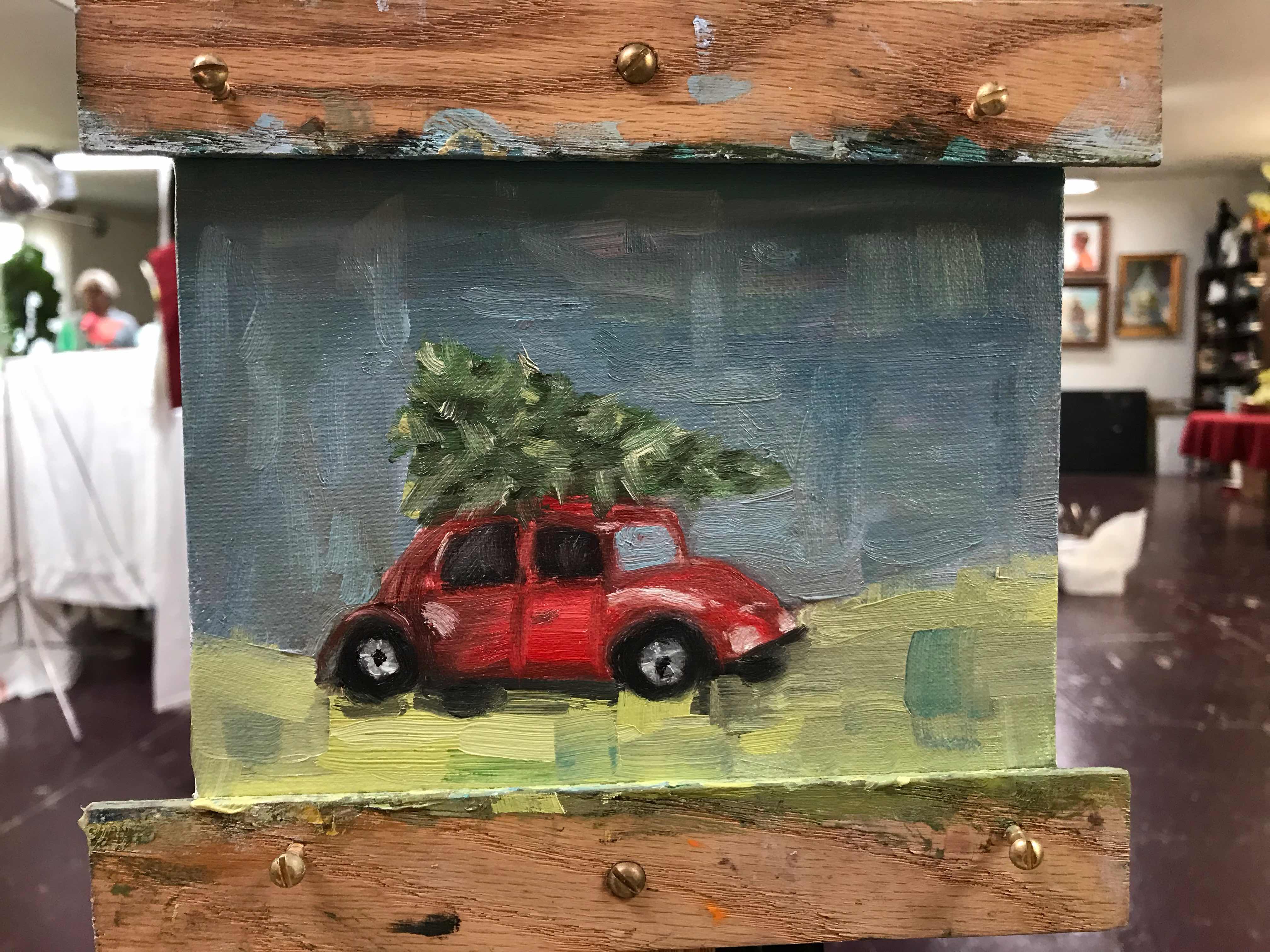
There was a huge four-sided still life in the middle of the studio - with lots of small objects. Everyone set up their easels in a circle all around the still life. So after lunch we selected an area of the still life to paint. I chose this little red VW with a Christmas tree tied on top. I would still like to do a little more work on this one - bump up the background maybe.


When I finished the car (or got as far as I felt I could at the time), I decided to do this little wreath that was on the wall of that side of the still life.  I want to do a little more work on it, too - some splashes of the bright local colors to liven it up a bit.


I decided to try this vase of flowers on the second day. It didn't go nearly as well as I'd hoped.  My colors got too thick and muddy. However, I like the vase. It's one of those paintings that will go in a stack somewhere - and someday I may paint over it or burn it. It's nothing I'd want to keep.


On the afternoon of the second day, I decided to try to paint Hershey Kisses.  Kim gave me some good suggestions. I really like this painting, although I think it looks better in person than in the photograph.


I finished the Hershey Kisses and still had a couple hours of workshop left.  I saw a snow globe and decided to paint that.  It's not finished, but the photo below shows how it looked by the time I left to drive home.  I will work on it more this coming week. I've been thinking through how to add the "snow" without getting it all over the entire painting.  LOL!  Artist problems!


I almost left out this one.  It's a 10-stroke exercise we did on the first day. It was to get basic shapes in with 10 strokes. After the 10-stroke exercise was over, I went back and added a background.  However, I don't like it - so I doubt I ever look at it again. LOL! 

It was a good workshop. Sometimes I "click" with an artist/instructor, and a couple times I've felt a workshop was a complete waste of time.  This was one of the good ones.  Kim was really helpful, and I felt that I learned a lot. I will be signing up with other workshops with her in the future.  However, for now, I'm done with workshops until January when I do three one-day Kathie Odom workshops in January.  Then I'm done with workshops until June when I take one from Dawn Whitelaw on "Drawing for Painters" which is something I need and am looking forward to.


A workshop with Rachael McCampbell

I signed up for a 5-week workshop with Rachael McCampbell. I've taken several workshops with her - including the week-long workshop at Arrowmont in Gatlinburg, TN back in October.  As it turns out, I will only be able to attend two of the five sessions.  Last week was the first session.  The second session will be December 12th.

The class is on landscapes.  Here is what I did last week.  It is based on a photo I took right outside of Gatlinburg during the Arrowmont week.


I like the little house on the left.  It was actually a barn.  However, I took artistic license and made it into a cabin. It seemed to fit in better with the painting.  I will be looking for what I want to paint at the next session.  This is actually one of my favorite paintings now.  I wish I had put the barn/cabin a couple inches further into the painting.  It's so far on the edge that in most photos, it hardly shows up.  When I frame it, the frame will probably cut off a little of it.


NOAPS 2021 Associate Member Online Exhibition

I'm happy to say that my painting, "Bear Creek Road Reflections" was chosen to be in the 2021 NOAPS (National Oil and Acrylic ...